 how-to
Miami Boat Rental Cancellation Policy Explained
Last Updated: October 23, 2026
Quick Summary
A boat rental cancellation policy sets the rules for whether you get money back, a credit, or nothing when you cancel. Deadlines count backward from departure time, and common windows run from 24 to 72 hours, so always check the individual listing's policy before paying.
- Deadlines count backward from your departure time, not from the day you booked.
- Some operators offer full refunds with 24 hours' notice, while others require 29 days or call all payments final.
- The captain, not the weather app, makes the final call on whether conditions are safe to depart.
- Rescheduling before your deadline often preserves more value than a late cancellation.
- Send your cancellation by email before the deadline and save the confirmation as a record.
Table of Contents
- Why Miami Boat Rental Cancellation Policies Vary So Much
- The Boat Rental Cancellation Deadline: What the Clock Actually Says
- Boat Rental Deposit Refund Rules and Refund Percentages
- Miami Boat Rental Weather Policy: Rain, Rough Water, and Who Decides
- How to Reschedule a Boat Rental Instead of Canceling
- How to Cancel and Document Your Request in Writing
- Refund Processing Times, Payment Methods, and What to Watch For
- Conclusion
- Frequently Asked Questions
Why Miami Boat Rental Cancellation Policies Vary So Much
A Miami boat rental cancellation policy is the set of rules that decides whether you get money back, a credit, or nothing at all when you cancel a reservation.
That variation is the first thing to understand. Getmyboat's Miami boat rental guidance notes that cancellation windows of 24 to 72 hours are common, but renters should always check the individual listing's policy.
Here is the honest picture. Some operators refund in full with 24 hours' notice. Others want 29 days. Some call every payment final.
The Boat Rental Cancellation Deadline: What the Clock Actually Says
The boat rental cancellation deadline is the last moment you can cancel and still recover part or all of your payment. Miss it, and the refund shrinks or disappears.
Deadlines are counted backward from your departure time, not from the day you booked. So a 72-hour window on a Saturday morning trip closes on Wednesday morning. Read the policy with your calendar open.
Most policies fall into a few buckets:
- Full refund with 24+ hours' notice: the most renter-friendly terms.
- Tiered refunds: full refund far out, partial refund closer in, nothing at the last minute.
- Long advance windows: some operators require notice weeks ahead for a full refund.
A Plain-Language Cancellation Timeline
Think of it as three zones. Far out (30+ days): you usually get the most flexibility, including date changes. Mid-range (3 to 7 days): partial refunds or credits are common. Short notice (within 12 to 48 hours): expect little or no refund, and a no-show typically costs you the full booking.
Here is how the notice you give maps to what you get back.
| Notice window | What to expect |
|---|---|
| 30+ days out | Most flexibility, including full refunds and free date changes |
| 7 to 29 days out | Partial refunds or credits are common |
| 3 to 6 days out | Refunds shrink further, some switch to credit |
| Within 48 hours | Little or no refund; no-show costs full booking |
Boat Rental Deposit Refund Rules and Refund Percentages
A boat rental deposit refund depends on two things: how much notice you gave and whether the deposit was refundable at all. Most operators apply a refund percentage that drops as your rental date gets closer, so the same deposit can be worth 100%, 50%, or 0% depending purely on timing.
Ask three questions before you pay:
- Is the deposit refundable, and under what notice period?
- What percentage comes back at each stage?
- Does the deposit convert to a booking credit instead of cash?
How Tiered Refund Math Actually Works
A tiered schedule is just a set of notice windows, each with its own refund percentage. A common pattern looks like this: full refund at 30 or more days out, a partial refund (often half) between 7 and 29 days, and no refund inside 7 days.
To turn a percentage into a dollar figure, multiply your total booking amount by the refund rate for the window you are in.
Two details change the math more than renters expect:
- What counts as the deposit. Some operators apply the refund percentage to the full booking total; others apply it only to the deposit and treat the balance as non-refundable. Confirm which base the percentage is calculated on.
- Fees deducted from approved refunds. A policy can approve a refund and still withhold a processing or administrative fee. Ask whether the fee is flat or a percentage, and whether it applies to credits as well as cash refunds.
Non-Refundable Bookings and Partial Refunds
Some bookings are simply non-refundable. This is real, not rare: one operator describes all payments as final and nonrefundable, while another sets a 29-day threshold for a full refund. Partial refunds usually kick in during the middle window, so confirm the exact percentage in writing before you pay.
A plain-language timeline makes the tiers easier to act on:
- 30+ days out: the most flexibility, including full refunds and free date changes on many policies.
- 7 to 29 days out: partial refunds or credits are common; the percentage depends on the operator's schedule.
- 3 to 6 days out: refunds shrink further, and some operators switch entirely to credit.
Worked Scenarios
- Group cancellation, 21 days out. A $1,200 group charter under a 50% mid-range policy returns $600, or a credit for the full amount if the operator prefers rebooking. Ask which option preserves more value.
- Late cancellation, 36 hours out. The same booking inside the short-notice window likely returns $0 cash. A credit, if offered, may still be available, confirm its expiration date.
- Date change instead of cancellation. Moving the booking inside the deadline often keeps the full value as a credit, which usually beats a partial cash refund.
Miami Boat Rental Weather Policy: Rain, Rough Water, and Who Decides
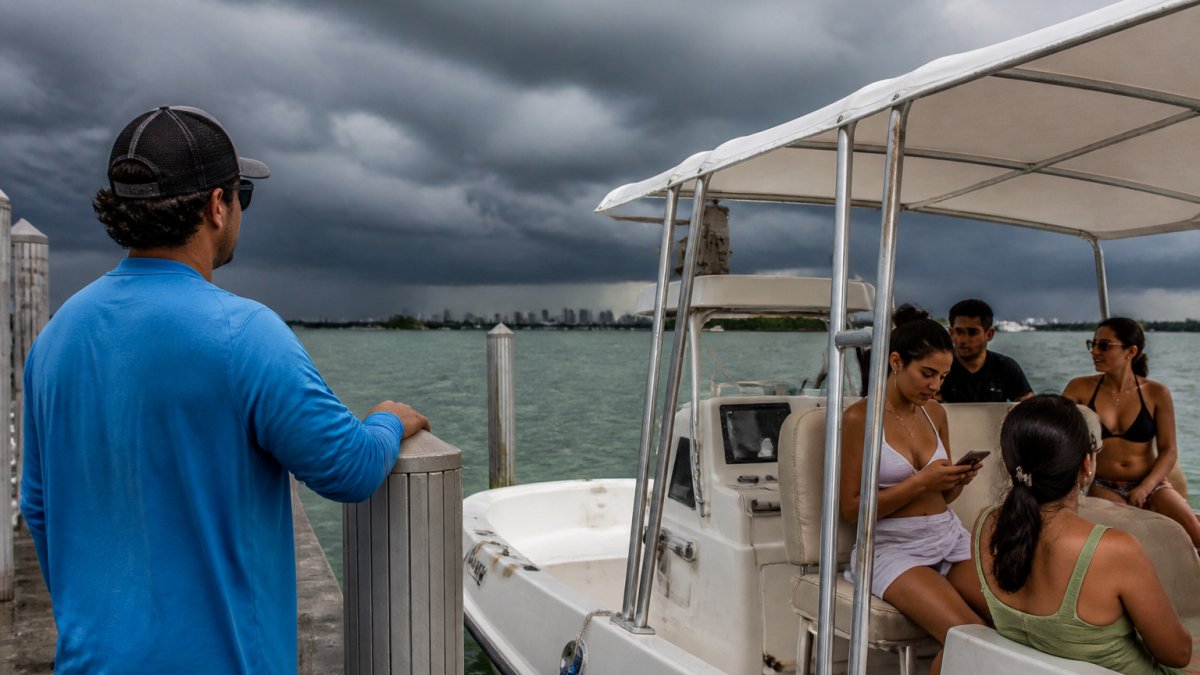
A Miami boat rental weather policy sets out what happens when conditions turn unsafe. The key point most renters miss: bad weather does not automatically mean a refund, and the forecast app on your phone is not the decision-maker.
Who Has the Final Say
The captain makes the final call on whether conditions are safe to depart. That authority is standard across the industry because the captain carries the legal and safety responsibility for everyone aboard.
This is where most disputes start. A renter sees rain in the forecast and assumes the trip is off; the captain sees a window of safe conditions and proceeds.
What Counts as Unsafe
Operators generally weigh a few concrete factors rather than a single forecast icon:
- Wind speed and gusts relative to the vessel's safe operating limits.
- Wave height and sea state in the planned cruising area.
- Lightning and severe-storm warnings issued for the departure window.
Rain alone is usually not disqualifying. Many charters run comfortably in light rain, and some of the best conditions come with passing showers. The decision turns on safety thresholds, not on whether the sky looks gray.
Refund, Credit, or Reschedule
When the captain calls off a trip for unsafe conditions, the outcome depends on the operator's policy. Three patterns are common:
- Reschedule first. Many operators prefer to move the booking to a future date, often at no extra cost, because it preserves the full value for both sides.
- Credit. If a reschedule is not possible, a booking credit for a future date is a frequent fallback. Check the expiration date.
- Refund. Cash refunds for weather cancellations are less universal than renters assume. Confirm in writing whether the policy offers a refund, a credit, or only a reschedule.
If the captain decides to proceed and you choose not to sail, that is a customer cancellation, not an operator cancellation, and the normal cancellation deadlines apply. This distinction is the single most important thing to clarify before you book.
What to Do When the Sky Looks Doubtful
- Call the operator before your scheduled start time and ask who makes the weather call.
- Ask what safety thresholds the captain uses and what the outcome will be, refund, credit, or reschedule.
- Get the decision and the remedy confirmed in writing, by email or text.
How to Reschedule a Boat Rental Instead of Canceling
To reschedule a boat rental, contact the operator before your cancellation deadline and ask for a date change to a future date. Many operators prefer rebooking over refunds, and a booking credit often preserves more of your money than a late cancellation.
Follow these steps:
- Check your policy for the reschedule window.
- Pick two or three alternate dates that work for your group.
- Send the request in writing, by email, so you have a record.
- Confirm any credit amount and its expiration date.
How to Cancel and Document Your Request in Writing
To cancel a boat rental, send a written cancellation request by email before your deadline and keep a copy of everything. A phone call is fine for speed, but written notice is what protects your refund.
Do this in order:
- Email the operator with your reservation number and rental date.
- State clearly that you are canceling and request written confirmation.
- Note the exact time you sent it, since deadlines are time-sensitive.
This paper trail matters if a refund dispute comes up later.
Refund Processing Times, Payment Methods, and What to Watch For
Refund processing times vary by operator and payment method. Card refunds usually take longer to appear than the cancellation itself, so build a buffer before you expect the money back. Ask the operator for an expected timeline in writing.
Watch for these common traps:
- Credits that expire: a booking credit is not cash, so check the expiration date.
- Processing fees: some policies deduct a fee even on approved refunds.
- Silent deadlines: confirm the deadline in writing rather than trusting memory.
Conclusion
Cancellation terms differ wildly across operators, and the fine print is where your money lives. The fix is to read the policy first, confirm deadlines and weather rules in writing, and document every request.
Our flexible rental durations let you book hourly rides or full-day adventures, and our guided water exploration means the plan is clear before you set out.
Frequently Asked Questions
What is the typical cancellation policy for a boat rental in Miami?
There is no single standard. Getmyboat notes that 24- to 72-hour cancellation windows are common, but each listing sets its own terms. In practice, the range runs wide: one operator offers a full refund with at least 24 hours' notice, another requires 29 days for a full refund, and some describe all payments as final and nonrefundable. Always read the boat rental cancellation terms on your specific reservation before you pay a deposit.
Are boat rental deposits refundable?
It depends on the operator and the notice you give. A boat rental deposit refund is usually tied to the cancellation deadline: cancel early enough and the deposit comes back, cancel late and it may be kept in full or partially. Some operators treat deposits as non-refundable regardless of timing. Ask two questions before booking: is the deposit refundable, and by what date must I cancel to get it back?
What happens to my booking if the weather is bad?
Do not assume rain means an automatic refund. The captain makes the final decision about rescheduling for extreme weather, and rain alone does not necessarily qualify. Confirm in writing who decides, what conditions count, and whether you get a refund, a credit, or a new date.
Can I reschedule a boat rental instead of canceling?
Often yes, and it is usually the cheaper path. Many operators prefer to move your reservation to a future date rather than issue a refund, sometimes as a booking credit with no expiration or a set window. Ask how many date changes are allowed, whether a rebooking fee applies, and how far ahead you must request the change. Get the new date confirmed by email so you have a record.