 blog
Best Places to Jet Ski in Miami: 7 Top Spots
Table of Contents
- Key Launch Points: Where to Start Your Jet Ski Miami Ride
- Biscayne Bay Routes and Miami Skyline Views
- Miami Jet Ski Tours: Guided vs. Independent Rides
- Sandbars, Small Islands, and Miami Beach Sightseeing
- Jet Ski Rental Prices in Miami: What Drives the Cost
- Miami Jet Ski Age Requirements and Passenger Suitability
- Jet Ski Safety Tips for Biscayne Bay Conditions
- Conclusion
- Frequently Asked Questions
Last Updated: October 16, 2026
Key Launch Points: Where to Start Your Jet Ski Miami Ride
Finding the best places to jet ski in miami starts with choosing the right launch point, because where you put in determines what you can see in the time you have. A launch spot near downtown gives you quick access to the skyline and the islands. A northern ramp puts you closer to the sandbars.
This section compares the actual places you put in, so you can choose by scenery, access, and route.
The Main Launch Areas, Compared
Riders generally launch from one of four areas.
Northern ramps (Haulover area). Nearest to Haulover Sandbar and the inlet. Best for riders whose main goal is the sandbar scene.
Miami Beach side (Collins Avenue / 41st Street corridor). Convenient if you're already on the beach, with quick access to the bay side and the intracoastal.
A common mistake is booking the cheapest launch without checking the travel time to the sights.
Parking, Transit, and Timing at Each Launch Point
Parking is the part most guides skip, and it's where a good day goes sideways.
- Downtown ramps fill early on weekends, and trailers need extra space that standard lots don't always have. Arrive before mid-morning if you're driving yourself.
- Mid-bay marinas usually have more room but charge for trailer parking, and the lots are shared with boaters who arrive at dawn.
- Northern ramps are the most trailer-friendly, which is why they draw the crowd. Get there early or expect to wait.
- Miami Beach side is the hardest for trailers. If you're staying on the beach, rideshare or walk to the marina instead of driving.
If you're staying in Miami Beach or downtown, rideshare to the marina often beats dealing with parking and traffic. For northern ramps, driving is usually simpler because transit options are thinner.
Book a slot in advance when you can. Walk-up availability disappears fast in peak season, and the difference between a 9 a.m. and an 11 a.m. start is often the difference between calm water and chop.
How to Choose by Rider Type
- First-timers: downtown or Miami Beach side, where the water is protected and the ride is short.
- Sandbar seekers: northern ramps near Haulover.
- Island hoppers: mid-bay marinas closest to the islands.
- Photographers: downtown, for the skyline angle.
- Experienced riders: any launch works, but mid-bay gives you the most route options in the least time.
Florida Fish and Wildlife Conservation Commission boating regulations
Biscayne Bay Routes and Miami Skyline Views
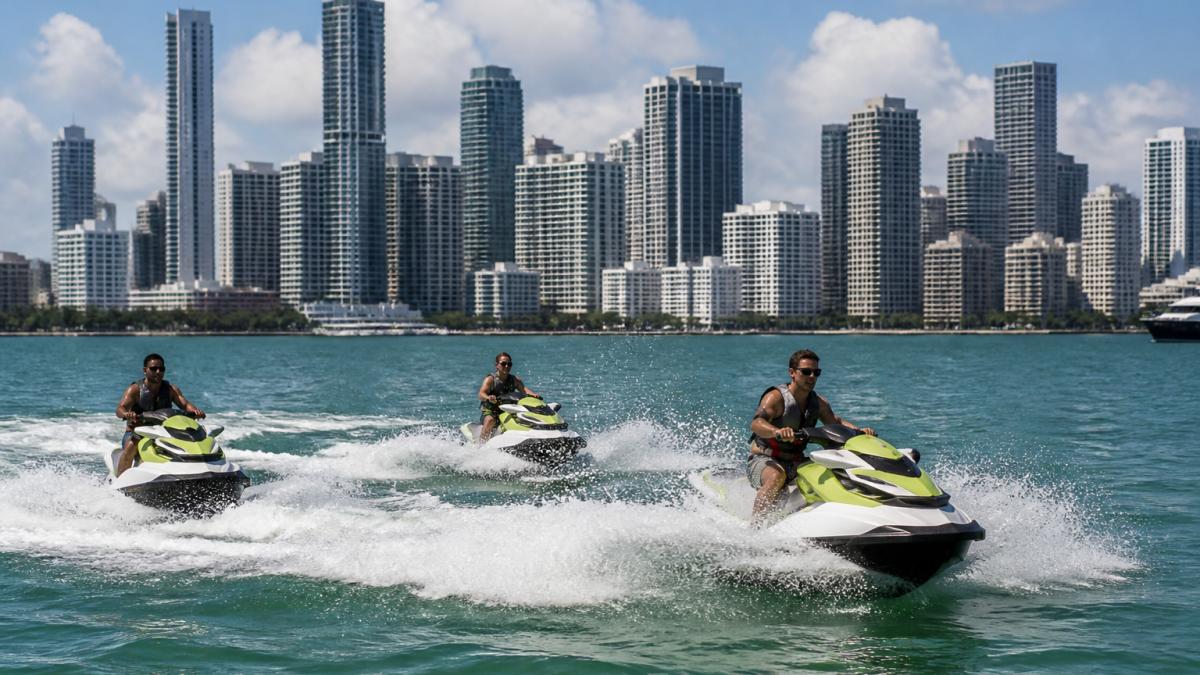
The classic ride runs across Biscayne Bay with the Miami skyline on one side and the open water on the other. This is the route most people picture, and it earns the hype.
A typical loop takes you past the downtown waterfront, out toward the islands, and back along the coast.
Star Island and Fisher Island Pass-Bys
Star Island and Fisher Island sit right in the middle of the good riding. Cruising past them is one of the main reasons people book a Biscayne Bay route.
You'll see waterfront homes, docks, and the kind of boats that make you reconsider your budget. Keep a respectful distance from private docks and moored vessels.
The pass-by works best as part of a longer loop. Ride the open water first, then slow down for the island stretch so you're not fighting wakes the whole time.
Miami Jet Ski Tours: Guided vs. Independent Rides
Guided tours put a professional guide out front who knows the route, the no-wake zones, and where the water stays calm.
Independent rentals give you freedom to roam. You need to know the rules, the boundaries, and how to read the water yourself.
For first-timers, a guided experience removes most of the stress.
| Factor | Guided Tour | Independent Rental |
|---|---|---|
| Navigation | Guide leads the route | You plan it |
| Best for | Beginners, first visit | Experienced riders |
| Sightseeing | Island and skyline highlights | Whatever you choose |
| Rules knowledge | Guide handles it | You must know them |
Miami Wave WaterSports runs guided jet ski rides that cover the skyline, the islands, and the sandbars in one trip.
Sandbars, Small Islands, and Miami Beach Sightseeing
Sandbars are the social heart of a Miami jet ski day. You ride out, drop anchor or beach the craft, and wade in waist-deep water while boats and riders gather around you.
The two names you'll hear most are Haulover Sandbar to the north and Nixon Sandbar closer to the middle of the bay. Both draw crowds on weekends and holidays.
Haulover Sandbar and Nixon Sandbar Basics
Haulover Sandbar sits near the inlet and gets busy fast. Nixon Sandbar is a popular mid-bay stop with shallow water that's easy to wade in. Both are best visited early before the afternoon crowd builds.
Small islands dot the bay between the mainland and the beach, and island hopping is a natural way to string a route together.
Watch your depth and your speed near the shallows. Grounding a rental is an expensive way to end a good day.
Jet Ski Rental Prices in Miami: What Drives the Cost
Rental prices vary by duration, craft, and whether you book guided or independent. There's no single number, and anyone quoting one flat rate for every situation is oversimplifying.
What moves the price:
- Duration - hourly rides cost less upfront than full-day adventures
- Guided vs. independent - a professional guide adds cost and value
- Group size - more craft means more total, sometimes at a better per-person rate
- Season and timing - peak weekends and holidays run higher
- Add-ons - boat rentals and sandbar experiences bundle in
The trap is a low headline rate that balloons with fuel charges, damage waivers, and dock fees. Ask what's included before you commit.
For current rates, check the Miami Wave WaterSports pricing page directly. We list what's included so there are no surprises at the dock.
Miami Jet Ski Age Requirements and Passenger Suitability
Age rules and passenger limits matter, and getting them wrong can sink a family outing before it starts. This is the section most competitors skip, so here's the practical version.
Who Can Operate a Personal Watercraft
In Florida, a person generally must be at least 14 years old to operate a personal watercraft legally. Anyone born on or after January 1, 1988 who operates a motorized vessel, including a PWC, must also carry a Florida Boater Education ID Card or an approved equivalent, unless a qualified adult is on board and directly supervising.
Rules can change, and rental operators can set stricter limits than the state. Confirm current requirements with the operator and with the Florida Fish and Wildlife Conservation Commission before you book.
What Rental Operators Typically Require
Most operators layer their own rules on top of state law. A common pattern:
- Minimum age to ride solo: 14 to 16, depending on the operator
- Minimum age as a passenger: often 6 to 8, sometimes with a weight minimum
- Boater safety card: required for operators born on or after January 1, 1988
- Parent or guardian signature: required for anyone under 18
- Photo ID: required at check-in for the cardholder
Ask two questions before you pay: what's the minimum age to drive, and what's the minimum age to ride as a passenger. The answers vary more than you'd expect.
Matching the Ride to Your Group
Passenger suitability depends on comfort, not just age. A rider who's nervous in open water has a better day as a passenger on a boat than gripping a handlebar in chop.
- Young children: best on a calm, protected route with a guide, and only if they meet the operator's passenger minimum.
- Teens who want to drive: confirm the operator allows solo operation at their age and that they have the safety card.
- Nervous adults: a guided ride on protected water beats an open-bay rental every time.
- Confident riders: a free ride is more fun, but know the boundaries before you go.
Florida Boater Education requirements and ID card
Jet Ski Safety Tips for Biscayne Bay Conditions
Safety on Biscayne Bay comes down to reading the water, knowing the rules, and wearing the right gear. Most incidents trace back to speed in the wrong place or ignoring a no-wake zone.
Core habits that keep a ride clean:
- Wear a properly fitted life jacket at all times
- Keep a safe distance from other craft and docks
- Respect idle and no-wake zones near marinas and the islands
- Watch for manatees and other wildlife in shallow water
- Carry a phone in a waterproof case and know the emergency channel
If you're new, start with a guided ride so someone experienced is watching the conditions with you.
Weather, Waves, and Seasonal Water Conditions
Morning rides usually offer the calmest water. Afternoon winds pick up, chop builds, and the bay gets bumpier. If you want smooth conditions, book early.
Summer brings heat, afternoon storms, and busy weekends. Winter and shoulder seasons run calmer and less crowded. Always check the marine forecast before you head out, and have a reschedule plan if the weather turns.
Ask about the weather policy before you pay.
Conclusion
Booking a jet ski day means juggling launch points, routes, age rules, and weather, and one wrong assumption can turn a great afternoon into a stressful one. Miami Wave WaterSports takes that off your plate with flexible hourly rides, full-day adventures, guided jet ski rides, and sandbar experiences built around the bay's best spots. We handle the route, the safety briefing, and the conditions so you can focus on the ride. Get started with Miami Wave WaterSports and see Biscayne Bay the way it's meant to be seen.
Frequently Asked Questions
How old do you have to be to ride a jet ski in Miami?
Florida law requires riders to be at least 14 years old to operate a personal watercraft, and anyone born on or after January 1, 1988 must hold a Florida Boater Safety Education ID card. Many rental operators, including Miami Wave WaterSports, set their own minimum age and often require riders under 18 to have a parent or guardian sign a waiver. Younger children can usually ride as passengers with an adult. Confirm the exact age policy and ID requirements when you book.
How much does it cost to rent a jet ski in Miami?
Jet ski rental prices in Miami depend on rental duration, whether you book a guided tour or a free ride, group size, and the season. Hourly and full-day options are both common, and guided experiences usually cost more than self-guided rentals. Miami Wave WaterSports lists current rates on its pricing page, so check there for exact figures before you book. Watch for add-ons like fuel, taxes, and damage deposits so you know the total cost up front.
Do you need a license to ride a jet ski in Miami?
No traditional driver's license is required, but Florida rules apply. Anyone born on or after January 1, 1988 must carry a Florida Boater Safety Education ID card to operate a personal watercraft. You can earn this by completing an approved boater safety course. Rental companies typically walk you through a short orientation on controls, no-wake zones, and local waterways before you launch. Bring a photo ID, and ask your rental operator what documentation they require.
Is it better to book a guided jet ski tour or rent on your own?
Guided tours suit first-time riders and visitors who want to see Biscayne Bay, the Miami skyline, Star Island, and the sandbars without planning a route. A professional guide handles navigation, points out landmarks, and keeps the group within safe areas. Independent rentals give experienced riders more freedom to explore at their own pace, but you are responsible for knowing no-wake zones, channel markers, and rules. If you are new to jet skiing or short on time, a guided experience removes most of the guesswork.